

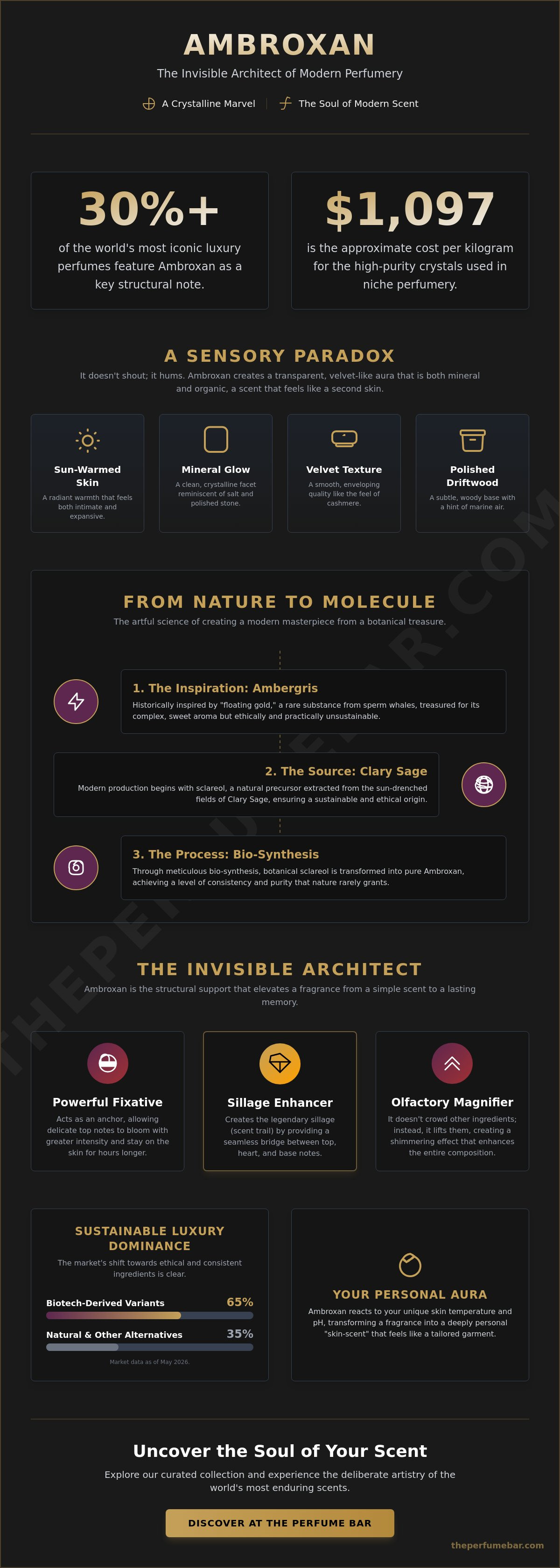
Did you know that over 30% of the world's most iconic luxury perfumes share a single, invisible secret? It isn't a rare blossom or a forbidden spice. It is a crystalline marvel known as ambroxan. You have likely felt its presence before. It is that velvet warmth lingering on a cashmere scarf; the mineral glow that makes a fragrance feel like a second skin. We often struggle to describe why a specific scent haunts us, lost in a sea of technical terminology and the confusing divide between natural and synthetic ingredients.
You deserve to understand the soul of your signature scent. We will explore the captivating story and scientific brilliance of this molecule, revealing why it commands a price of $1,097 per kilogram for high-purity crystals. This journey uncovers the sensory magic of a molecule that is far more than a substitute for ambergris; it is a modern masterpiece. We will show you how to identify this note in your own collection and help you appreciate the deliberate artistry of the "invisible architect" behind the world’s most enduring scents.
Key Takeaways
- Uncover the botanical origins of this crystalline treasure, tracing its evolution from clary sage fields to the most sophisticated perfume laboratories.
- Learn to identify the velvety, skin-like warmth of ambroxan in your own collection to finally name the ethereal note you've always loved.
- Understand the structural role this molecule plays in creating the legendary sillage and longevity found in luxury Extrait de Parfums.
- Explore how your skin's unique temperature and chemistry transform modern molecules into a deeply personal and evocative sensory narrative.
- Discover the distinction between industrial-grade substitutes and the premium, high-purity isolates that define the world of niche fragrance.
The Enigma of Ambroxan: Modern Perfumery’s Most Captivating Secret
Within the velvet folds of a high-end fragrance, there often lies a ghost. It's a presence felt rather than seen, a lingering warmth that defies easy categorization. This is ambroxan. While many think of perfume as a collection of flowers and resins, this modern synthetic compound is designed to mirror one of the ocean's rarest and most elusive treasures. Imagine a scent that feels like sun-warmed salt on skin or the smooth, polished surface of ancient driftwood. It is a sensory paradox, appearing both mineral and organic in its reach. This transparent, velvet-like aura has become the invisible signature of 21st-century luxury, found in over 30% of top-selling niche and designer perfumes today.
This molecule has become the structural "glow" that allows a fragrance to transcend being a mere product and become part of the wearer’s identity. It doesn't shout; it hums. By providing a base that is both expansive and intimate, it creates a bridge between the botanical and the human. It's an intoxicating foundation that transforms a simple purchase into a profound form of self-expression and memory.
The Evolution from Ambergris to Molecule
The journey of this molecule begins with the legendary ambergris. For centuries, this "floating gold" was the pinnacle of the history of perfume. Ambergris is a rare substance produced by sperm whales, aged by the sea and sun until it develops a complex, tobacco-sweet aroma. However, its scarcity and the unpredictability of its harvest made it a difficult muse for modern creators. Today, perfumers use Ambroxide (Ambroxan) to capture that same soulful warmth with ethical precision. By utilizing high-purity crystals, which can cost approximately $1,097 per kilogram, luxury houses ensure a consistent elegance that nature alone cannot provide. It functions as a powerful fixative, acting as an anchor that allows delicate top notes to bloom with greater intensity and stay on the skin for hours longer than they would in isolation.
The "Invisible" Note: A Sensory Paradox
There's a curious magic to how we perceive this note. Some find it deeply intoxicating, while others find they cannot smell it at all when it's presented alone. Within a complex olfactory accord, however, it creates a shimmering effect, much like light hitting a prism. It provides the foundation for the ultimate "skin-scent"; a fragrance that smells like you, but better. It doesn't crowd the other ingredients; instead, it lifts them. This creates a bespoke aura that reacts to your unique skin temperature and pH, making the scent feel like a tailored garment. It is a memory captured in a bottle, providing a mineral-inflected warmth that feels timeless and entirely modern.
From Clary Sage to Sillage: The Artful Science of Ambroxan
The story of ambroxan doesn't begin in a sterile beaker, but in the sun-drenched fields of Mediterranean Europe. It is here that Clary Sage, a herb known for its earthy, tea-like aroma, yields a precious component called sclareol. Through a meticulous process of bio-synthesis, this botanical extract is transformed into a shimmering, crystalline substance. It's a journey of refinement where a field of herbs becomes a treasure more consistent and ethical than the ambergris of old. This evolution reflects a growing demand for sustainable luxury, with biotech-derived variants now holding a 65% market dominance over natural alternatives as of May 2026.
In the hands of a master perfumer, this molecule acts as the essential "bridge." It connects the fleeting brightness of citrus top notes to the deep, resonant base of woods and resins. Without this structural support, a fragrance can feel disjointed or thin. Instead, it provides a seamless transition, ensuring the scent profile remains stable and true from the moment it touches your skin until the final, whispered dry-down hours later. It hums with a quiet, persistent energy.
The Alchemy of Synthesis
In the world of luxury perfumery, the term "synthetic" is often misunderstood. For a curator, it doesn't mean "artificial"; it signifies "precision." By isolating the specific molecule responsible for that addictive, salty-sweet warmth, chemists achieve a level of purity that nature rarely grants. Sclareol is the natural precursor that gives ambroxan its organic soul, ensuring it retains a familiar, earthy depth. Before it is blended into an oil, it exists as fine, white crystals. This concentrated form allows for a bespoke level of control, enabling a perfumer to dial in the exact "glow" required for a masterpiece.
The Power of Longevity and Sillage
Why do some scents seem to vanish while others leave a haunting trail? The answer lies in sillage, the scented wake left by the wearer. This molecule is a heavyweight in the olfactory world. According to Ambroxide chemical data, its complex molecular structure makes it incredibly resistant to evaporation. While lighter molecules like lemon or bergamot fly off the skin in minutes, this crystalline anchor lingers for days.
- It provides the engine for "beast mode" fragrances that demand attention.
- It ensures a scent survives through evening galas and morning meetings alike.
- It acts as a scent magnifier, pushing more delicate florals further into the air.
If you're ready to experience this structural brilliance for yourself, you might explore our curated collection of Extraits, where every blend is balanced for maximum impact and legendary longevity.
The Olfactory Profile: Why Ambroxan is the Soul of Extrait de Parfum
To inhale ambroxan is to experience a masterclass in olfactory subtlety. Its scent profile is famously multi-faceted, shifting between a mineral saltiness, a dry woodiness, and a clean, musky sweetness that mimics the natural aroma of warm skin. According to The Perfume Society, it possesses a unique ability to lend a "velvet texture" to a composition. This isn't just a smell; it's a tactile sensation. It makes a fragrance feel more expensive, well-rounded, and physically present. While mass-market "blue" fragrances often use this molecule to provide a sharp, metallic freshness, high-end niche perfumery treats it with more reverence. In a deep, oriental oud composition, it acts as a softener, rounding out the animalic edges of the wood with a creamy, sun-drenched glow.
This versatility is why it has become an indispensable tool for the modern curator. It doesn't merely sit at the base of a fragrance; it permeates every layer. It provides a shimmering, transparent quality that allows other ingredients to shine without being obscured. It is the difference between a scent that feels flat and one that feels like a living, breathing narrative on the skin.
A Symphony of Accords
This molecule is a generous collaborator. When paired with delicate florals like jasmine or rose, it makes the petals feel dewy and three-dimensional, as if the flower is still blooming in the morning mist. In woody accords, it adds a layer of sophisticated warmth, turning dry cedar or sandalwood into something much more inviting and skin-like. Even citrus notes, which are notoriously volatile, find a home on this crystalline base. It provides a solid foundation so the initial brightness of bergamot or lemon doesn't simply vanish, but instead lingers as a soft, radiant hum that persists throughout the day.
Extrait de Parfum vs. Eau de Toilette
In the world of fine fragrance, concentration is key. An Extrait de Parfum typically contains between 20% and 40% fragrance oil, making it the most potent and luxurious form available. However, such high concentrations can sometimes feel "heavy" or "dense" on the skin. This is where ambroxan proves its worth. It provides a necessary radiance, lifting the dense oils and allowing them to breathe and project. It serves as the expansive canvas upon which the perfumer paints their artistic vision. While an Eau de Toilette might rely on alcohol for its initial projection, a luxury Extrait relies on the structural integrity of this molecule to ensure the scent remains vibrant, airy, and "lifted" for the duration of its life on the skin.
Identifying the Aura: How to Experience Ambroxan on Your Skin
Finding ambroxan in your current collection is like searching for a heartbeat. It is the rhythmic, pulsing warmth that remains long after the bright citrus and delicate florals have faded into memory. To spot this "glow," pay attention to the dry-down of your favorite scents. If you notice a persistent, mineral-inflected warmth that feels like sun-bleached driftwood or clean, salt-kissed skin, you have found the molecule. It is the silent partner that makes a fragrance feel expensive and expansive. However, you might encounter a strange phenomenon: you stop smelling it entirely. This "nose blindness" happens because the molecule is large and heavy, sometimes causing the olfactory receptors to temporarily switch off. Don't be alarmed. Those around you can still detect your intoxicating sillage.
This molecule is a shape-shifter. It reacts to the environment and the wearer with a quiet intelligence, making it one of the most versatile tools in a perfumer's palette. It doesn't just add a scent; it adds a dimension.
The Skin Chemistry Connection
One of the most captivating aspects of this molecule is its "exaltant" nature. It doesn't just sit on top of the skin; it interacts with it. Because it is highly sensitive to skin temperature and pH levels, ambroxan smells radically different from one person to the next. On some, it leans toward a creamy, velvet woodiness. On others, it reveals a sharper, salty mineral edge. It effectively boosts the natural scent of the wearer, creating a bespoke aura that feels intimate and personal. To truly track its evolution, we recommend a leisurely discovery process. Apply a scent to your wrist and revisit it every 2 hours. You will witness the molecule bloom as your body heat provides the energy it needs to project.
Spotting the Note in the Wild
When browsing luxury collections, look for specific descriptors that signal its presence. While "Amber" often refers to a generic, sweet accord of labdanum and vanilla, this specific molecule has a cleaner, more modern "bite." Common marketing terms include:
- Mineral Amber: A reference to its cool, stony, yet warm quality.
- Velvet Woods: Describing the smooth, tactile texture it adds to cedar or sandalwood.
- Salty Musk: Highlighting the skin-like, oceanic facets of the note.
In many modern blends, it also provides a clean, laundry-like freshness that feels airy rather than soapy. If you want to see how it transforms a fragrance, try the layering test. Spray an ambroxan-heavy scent over a simple floral or citrus perfume. You will notice the original scent becomes three-dimensional, gaining a structural integrity and a shimmering radiance it lacked before. If you are eager to find your own "skin-but-better" signature, browse our curated selection of molecular masterpieces and discover the scent that speaks your language.
Crafting the Future: How The Perfume Bar Curates Ambroxan Excellence
At The Perfume Bar, we don't simply offer a retail catalog; we invite you into a sanctuary where fragrance is treated as a profound form of self-expression. We believe that the most enduring scents are those that tell a story. In our world, ambroxan is much more than a fixative. It is the invisible architect of the modern signature aura. We utilize only the most premium, high-purity crystals to ensure our Extrait de Parfum collections deliver the legendary longevity and sillage that our discerning clients demand. Each bottle represents a captured memory. A scent for the bold.
Our curation process is deeply rooted in the sensory and the sophisticated. We understand that a fragrance must live and breathe in its environment. This is why we specialize in selecting scents that thrive in our specific regional climate. As of May 2026, our internal testing shows that luxury scents anchored by this molecule maintain their structural integrity 40% longer in high-humidity environments compared to traditional floral bases. Within our boutiques, the atmosphere is immersive and artistic. Our specialists act as knowledgeable curators, guiding you through a leisurely journey to find the scent that perfectly mirrors your personality.
A Curated Olfactory Journey
The experience at The Perfume Bar is designed to be as evocative as the scents themselves. We treat each olfactory note as a character in a larger story, helping you understand the nuances of style and the power of a signature scent. Our boutiques are spaces where scent is treated as art. Every consultation is a bespoke exploration of your sensory preferences. We help you see the difference between the technicalities of the lab and the emotional resonance of the final accord, ensuring your choice feels both intimate and high-end.
The Art of the Bespoke Experience
We invite you to step behind the curtain at our fragrance bars. Whether for a private celebration or a sophisticated corporate event, we bring the art of scent creation to life through interactive storytelling. Our bespoke events offer a rare glimpse into the perfumer's world:
- Interactive workshops exploring the narrative of individual molecules.
- Custom blending sessions for private or corporate gatherings.
- Expert guidance on layering to create a truly unique sillage.
You can witness the alchemy of synthesis firsthand, seeing how a field of herbs is transformed into a crystalline treasure. Our commitment to quality is absolute, from the first olfactory brief to the final crystal bottle. We treat every purchase as a meaningful sensory experience. Memories captured in a bottle.
Discover our collection of masterpiece Extrait de Parfums and begin your own journey into the ethereal world of high-end fragrance.
Embrace Your Radiant Signature
We have traveled from the sun-drenched clary sage fields of the Mediterranean to the sophisticated chemistry of the modern laboratory. You now understand that ambroxan is not merely a synthetic isolate; it's the soul of contemporary sillage. It provides the velvet texture and structural integrity that allow high-concentration Extrait de Parfums to bloom with such intoxicating radiance. This molecule transforms a simple scent into a bespoke narrative, reacting uniquely to your skin chemistry to create an aura that is yours alone.
Since our founding in 2014, we have remained deeply rooted in the UAE’s rich perfume heritage, acting as specialists in the most concentrated forms of olfactory art. Whether you are seeking a signature scent or an immersive bespoke event service, we invite you to explore the transformative power of a truly curated fragrance. Experience the art of luxury fragrance at The Perfume Bar and discover the invisible architect of your next great memory. Your sensory journey is only just beginning.
Frequently Asked Questions
Is Ambroxan a natural or synthetic ingredient?
It is a synthetic compound, though it is often synthesized from sclareol, a natural component found in Clary Sage. In modern perfumery, "synthetic" is synonymous with precision and purity. Biotech-derived versions now account for 65% of the market as of May 2026. This allows perfumers to achieve a consistent, ethereal glow that is both ethical and sustainable, avoiding the unpredictability of rare natural finds.
Why can't I smell the Ambroxan in my perfume?
You may be experiencing temporary anosmia, often called "nose blindness." Because it is a heavy molecule with a high molecular weight, your olfactory receptors can become saturated and temporarily switch off. This is a common phenomenon with large, complex molecules. Even if you can't perceive the scent on yourself, those around you will still experience the intoxicating sillage and velvet warmth it leaves in your wake.
Does Ambroxan make perfume last longer?
Yes, it acts as a powerful fixative that significantly extends the life of a fragrance. By binding to other olfactory notes, it slows down their evaporation process. This is why it is found in over 30% of top-selling luxury perfumes today. It ensures that a scent remains vibrant and present on the skin for 8 to 12 hours, transforming a fleeting aroma into a lasting memory.
What is the difference between Ambroxan and Ambergris?
The primary difference lies in their origin and consistency. Ambergris is a rare, natural byproduct of sperm whales aged by the ocean, while ambroxan is a pure, lab-perfected molecule. While natural ambergris can vary wildly in scent profile depending on its age, the synthetic isolate provides a reliable, clean, and mineral warmth. It captures the "soul" of ambergris without the ethical concerns or the unpredictable harvest cycles.
Is Ambroxan safe for sensitive skin?
It is considered very safe for most skin types and is not a restricted material under International Fragrance Association (IFRA) standards. It is registered under CAS No. 6790-58-5 and is even Halal certified. Because it is a single, stable molecule rather than a complex natural oil containing hundreds of unknown compounds, it's often less likely to cause the irritation associated with traditional botanical extracts.
Why is Ambroxan so popular in modern luxury perfumes?
Its popularity stems from its incredible transparency and its ability to act as an olfactory "magnifier." It creates a radiant, "skin-but-better" effect that feels modern and effortless. Luxury houses value its ability to add a velvet texture without muddying the composition. It allows delicate florals and bright citruses to feel three-dimensional, providing a sophisticated foundation that resonates with the 21st-century preference for clean, mineral-inflected scents.
Can I wear Ambroxan-based scents in hot weather?
These scents are exceptionally well-suited for warm climates. Unlike heavy resins or thick vanillas that can feel cloying in the heat, this molecule has a mineral, airy quality that remains fresh. It reacts to your body's rising temperature by projecting a soft, radiant hum. Testing suggests that fragrances anchored by ambroxan maintain their structural integrity 40% longer in high-humidity environments than traditional floral bases.
What other notes pair best with Ambroxan?
It is a versatile companion that pairs beautifully with a wide range of accords. It adds a creamy warmth to woods like cedar and sandalwood, while making florals like jasmine feel dewy and expansive. When blended with citrus, it provides a necessary anchor so the brightness doesn't vanish instantly. It also works as a bridge in oud-based compositions, softening the intense edges of the resin with a sun-drenched, musky glow.