

What if the liquid gold in your crystal flacon was once a sacred smoke used to carry prayers to the heavens in 2,000 BCE? You likely understand that a fragrance is more than just a pleasant aroma; it’s a silent language of identity and memory. It’s an intoxicating sensory signature that lingers in a room long after you’ve departed. We’ll guide you through the 4,000-year evolution of the history of perfume, unraveling the mysteries of ancient resins and the meticulous craft behind today’s high-concentration extrait de parfum. You’ll learn how technical processes like steam distillation, perfected by Al-Kindi in the 9th century, paved the way for the complex accords we adore today. This journey connects the ancient rituals of the Levant to the sophisticated world of modern luxury. From the earliest Mesopotamian stills to the bespoke laboratories of modern Dubai, we’re exploring how raw nature is transformed into bottled art that defines your personal sillage.
Key Takeaways
- Journey back to Mesopotamia to meet Tapputi, the world’s first chemist, and discover how scent began as "per fumus"—a sacred smoke connecting the earthly to the divine.
- Trace the enchanting history of perfume through the Golden Age of Islam, where the perfection of steam distillation transformed heavy resins into the ethereal floral waters we adore today.
- Uncover how the French court turned fragrance into a royal obsession, evolving the town of Grasse from humble beginnings into the world's most prestigious perfume capital.
- Explore the 19th-century chemical revolution that introduced synthetic molecules, bridging the gap between natural essences and the democratization of modern luxury.
- Understand why the modern resurgence of Extrait de Parfum represents the ultimate pinnacle of olfactory sillage, offering a depth and concentration that honors ancient artisanal traditions.
The Sacred Smoke: The Dawn of Fragrance in the Ancient World
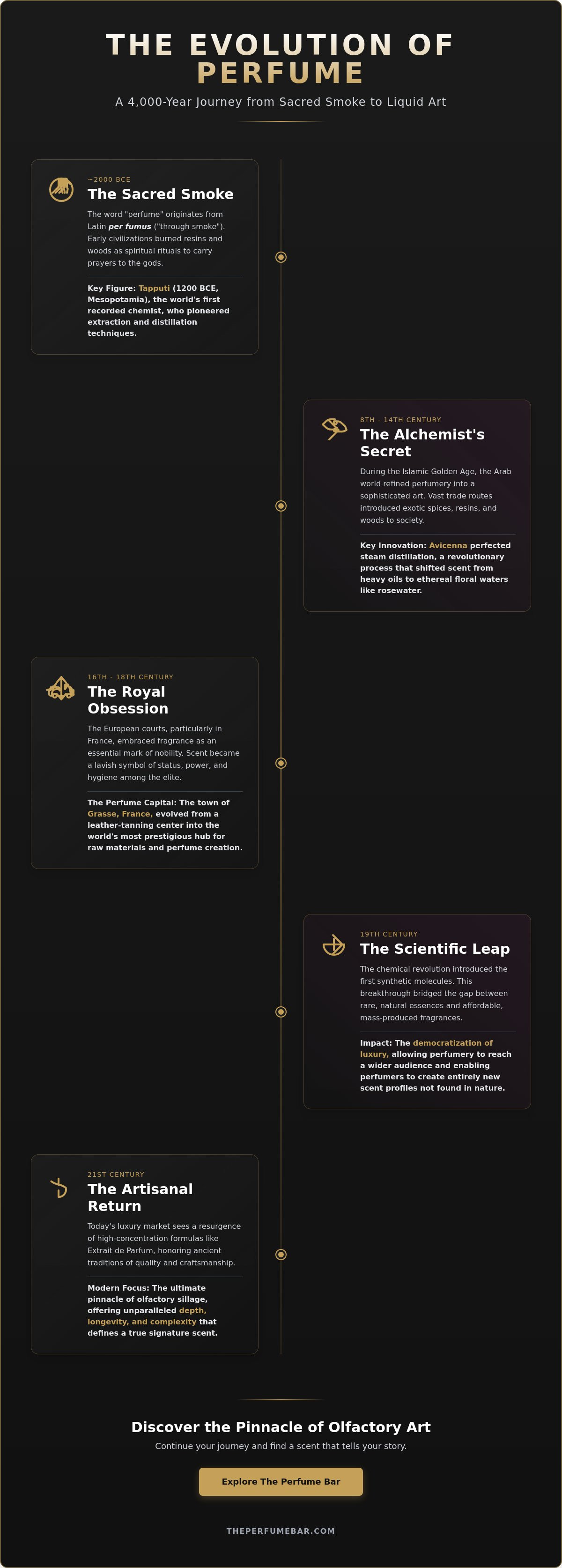
Long ago, before the glass flacons of today, scent was a bridge between the earth and the heavens. The very word perfume finds its roots in the Latin per fumus, meaning "through smoke." This wasn't a casual vanity. It was a ritual. For the earliest civilizations, burning precious resins and aromatic woods was the only way to communicate with the gods. They believed the rising plumes carried their deepest petitions to the divine. This spiritual beginning marks the true history of perfume, a journey that began not in a laboratory, but at the altar. It was an ethereal medium for the soul.
Tapputi and the Birth of Perfumery Chemistry
In the year 1200 BCE, a woman named Tapputi Belatekallim served as a palace overseer in Babylonian Mesopotamia. We know her name because it's etched into cuneiform tablets, marking her as the world's first recorded chemist. She didn't just mix scents; she mastered the art of extraction. Tapputi used flowers, oil, and calamus along with cyperus and myrrh to create the first complex olfactory layers. Her process involved adding water or other solvents, then stripping away the impurities through repeated distillation. Tapputi’s pioneering use of chemical processes like sublimation and extraction established the fundamental techniques that every modern master perfumer still relies upon today.
Egypt’s Olfactory Tapestry: From Temples to Toilets
Ancient Egypt elevated scent to an art form that defined the rhythm of life and death. The sun god Ra was honored with a specific olfactory cycle: resin at dawn, myrrh at noon, and the complex 16-ingredient incense known as Kyphi at sunset. As the centuries passed, these sacred scents transitioned from temple altars to the dressing tables of the nobility. Cleopatra famously used fragrance as a political tool, reportedly soaking the sails of her ship in jasmine oil to announce her arrival before her boat was even visible. This shift turned scent into a tool of seduction and influence.
Fragrance became a signature of power. It was a shield against the mundane. In the heat of the Nile, scented ointments and oils weren't just luxuries; they were symbols of immortality and status. By the time the New Kingdom arrived around 1550 BCE, the elite used fragrance to signal their proximity to the gods and their distance from the common world. To be scented was to be divine.
- Kyphi: A sacred blend of honey, wine, raisins, and myrrh used for evening rituals.
- Sillage of Power: The use of heavy oils to signify wealth and high social standing.
- Botanical Mastery: The cultivation of lilies and roses specifically for their aromatic properties.
The history of perfume is a testament to our desire to capture the intangible. In these ancient times, a scent was more than a smell; it was a person's aura, their prayer, and their legacy. It was the first step in a long, aromatic evolution that continues to define our personal narratives today.
The Alchemist’s Secret: How the Arab World Refined the Art of Scent
During the Golden Age of Islam, spanning roughly from the 8th to the 14th century, the Arab world transformed perfumery from a primitive ritual into a sophisticated liquid art. Merchants and explorers utilized vast trade routes to bring exotic spices, rare resins, and precious woods to the forefront of society. These bustling markets in Baghdad and Damascus became the heart of a sensory revolution. It was a time when fragrance wasn't merely a luxury; it was a profound expression of culture and spirituality.
Avicenna and the Revolution of Distillation
In the 10th century, the Persian polymath Ibn Sina, known to the West as Avicenna, achieved a breakthrough that forever altered the history of perfume. He perfected the process of steam distillation. Before this innovation, scents were typically heavy, oil-based infusions that sat thick on the skin. Avicenna’s refrigerated coil allowed for the extraction of pure rosewater, creating an ethereal, liquid sillage that felt like a delicate whisper. This transition from dense, resinous mixtures to refined floral waters laid the groundwork for the high-concentration extracts we admire today. You can explore the chemical principles behind these early milestones in The Story of Perfume, which highlights how these alchemical processes defined the industry's scientific backbone.
This technological leap meant that the soul of a flower could finally be captured in a bottle. It wasn't just chemistry; it was poetry in a vial. These refined liquids offered a clarity and vibrance that previous generations couldn't imagine. It's the reason why the rose remains a cornerstone of fine fragrance centuries later.
The Spice Trail: Scent as Global Currency
The regional trade network thrived on the movement of Frankincense from Oman and Myrrh from Yemen. These materials were more than just ingredients; they functioned as a form of global currency. By blending these resins with Indian sandalwood and Himalayan musk, Arab perfumers developed a entirely new olfactory language. This era birthed the deep, intoxicating "oriental" accords that continue to define the history of perfume and dominate modern niche collections.
- Musk: Prized for its animalic warmth and its ability to anchor a scent for hours.
- Amber: A sweet, balsamic resin that provides a golden, glowing depth to any composition.
- Oud: The legendary "liquid gold" derived from agarwood, which remains central to Emirati identity and luxury.
By the 12th century, returning "Perfume Crusaders" began carrying these sophisticated techniques and exotic ingredients back to Europe. They brought with them the secrets of the alembic and the intoxicating scents of the East, sparking a sensory awakening in the West. These ancient traditions still breathe life into our modern curated collections, where every drop tells a story of heritage and refinement.
The Perfumed Court: Europe’s Royal Obsession with Fragrance
The Renaissance sparked a sensory revolution that redefined the history of perfume in Europe. This shift began in earnest when Catherine de’ Medici arrived at the French court in 1533. She brought her personal perfumer, René le Florentin, whose secret formulas were as guarded as royal jewels. This Italian influence transformed Paris into a hub of olfactory artistry. Fragrance was no longer just a ritual; it was an essential element of high-society identity. It was the beginning of an era where scent and status were inextricably linked.
Scented Gloves and Italian Influence
The practical origins of French perfumery were surprisingly gritty. In the 16th century, Grasse was a center for tanning leather, a process that left hides with a foul, lingering odor. To make luxury goods palatable, artisans began infusing gloves with floral essences like mimosa, jasmine, and violet. These scented gloves became the height of fashion. Italian masters soon opened boutiques across Paris, catering to an elite that demanded bespoke blends. Fragrance became a signature of the soul. It was a way to announce one's presence before a single word was spoken. By the mid-1700s, Grasse had fully pivoted from leather to flowers, cementing its status as the world's perfume capital.
Louis XIV and the Versailles Olfactory Rituals
At the height of the 17th century, King Louis XIV turned scent into a political instrument. His court at Versailles was a theater of the senses where fragrance often replaced traditional hygiene. The Sun King's appetite for scent was legendary; he reportedly required a different perfume every day to reflect his absolute authority. He didn't stop at personal adornment. He ordered the palace fountains to be filled with rosewater and orange blossom, ensuring every breeze carried a royal accord. The Story of Perfume details how this era established the concept of a fragrance wardrobe. Scent was no longer a single signature but a collection of moods. This tradition of curated luxury continues to influence how we approach niche fragrances in the UAE today, where a scent is viewed as a profound form of self-expression and a mark of hospitality.
The heavy, musk-laden scents of the 17th century eventually gave way to a new era of freshness. In 1709, the birth of the first Eau de Cologne offered a crisp departure from the past. Created by Giovanni Maria Farina, this blend of citrus and herbs felt like a breath of fresh air. It was light. It was invigorating. It moved away from the dense, animalic notes that had dominated for centuries. This evolution in the history of perfume paved the way for the sophisticated, layered compositions that define modern high-end perfumery. Every bottle became a memory captured, a story waiting to be told through the delicate dance of top, heart, and base notes.
The Industrial Revolution of Scent: From Nature to the Laboratory
The late 19th century marked a seismic shift in the history of perfume, moving the craft from the garden to the laboratory. Before this era, scents were strictly botanical, tethered to the availability of harvests and the whims of nature. The breakthrough came in 1874 with the synthesis of vanillin, followed closely by coumarin. These synthetic molecules didn't just replicate nature; they offered a stability and intensity that raw extracts lacked. This technological leap democratized luxury. Fragrance was no longer a guarded secret of the European aristocracy or the royal courts of the East. As production costs stabilized, a burgeoning middle class began to seek out these bottled dreams, viewing them as essential markers of status and personal identity.
This period also witnessed the birth of the "Couture Perfume." Fashion houses realized that a scent could serve as an invisible hemline, a way to wrap a client in the brand’s entire aesthetic. To match the liquid artistry inside, the vessels themselves became masterpieces. Collaborations with glassmakers like Lalique and Baccarat turned perfume bottles into sculptural icons. In the UAE market, where the vessel's weight and design often reflect the prestige of the juice within, this tradition of ornamental glass remains a vital part of the sensory experience.
The Birth of Modern Perfumery (1880–1920)
Modernity arrived with a bold, abstract stroke. In 1882, Paul Parquet created Fougère Royale, the first fragrance to use synthetic coumarin, birthing an entire family of scents that smelled of "ferns" despite ferns having no natural extract. This era culminated in 1921 with Chanel No. 5. By utilizing aldehydes, Ernest Beaux created a sparkling, "clean" profile that didn't mimic a specific flower. It was a revolution in the history of perfume, proving that a scent could be a conceptual work of art rather than a mere botanical imitation.
The Era of the Great Noses
As the 20th century progressed, the "Nose" emerged from the shadow of the laboratory to become a celebrated artist. The role shifted from a technician mixing resins to a visionary crafting a narrative. In our region, we've always valued the technical prowess of a scent, particularly its sillage and longevity. These aren't just technical metrics; they're signatures of quality that define the niche movement. Today, the distinction between mass-market fragrances and bespoke niche creations lies in this artist-led approach, where the storyteller prioritizes the evocative power of the note over sheer commercial appeal.
Experience the evolution of liquid artistry for yourself. Discover our curated collection of modern masterpieces and find the scent that tells your story.
A New Era of Luxury: The Return to Artisanal Extrait de Parfum
The modern fragrance landscape is undergoing a quiet but profound revolution. Discerning collectors in the UAE are increasingly rejecting the fleeting, "watered-down" compositions that dominated the late 20th century. Instead, there's a passionate return to the artisanal roots of the craft. This shift honors the 4,000-year history of perfume by prioritizing depth, complexity, and raw raw materials over mass-market appeal. It's a move toward the Extrait de Parfum, a concentration that mirrors the potency once reserved for the pharaohs and emperors of the ancient world. Since the 2010s, the demand for niche fragrances has grown by approximately 10% annually, signaling a desire for scents that linger long after a person has left the room.
The Resurgence of the Extrait
An Extrait de Parfum represents the absolute pinnacle of olfactory concentration. While a standard Eau de Parfum typically contains 15% fragrance oil, an Extrait boasts a composition of 20% to 40%. This isn't just about strength; it's about the architecture of the scent. With a lower alcohol content, the fragrance reveals its base notes almost immediately, creating a rich, intimate sillage that often lasts for 12 hours or more. In the luxury markets of Dubai and Abu Dhabi, this "pure" form is the gold standard. It reflects the same uncompromising quality found in antiquity, where rare resins and precious oils were traded like currency. It's a deliberate, slow-release sensory experience that demands attention through its subtlety and soul.
The Perfume Bar: Your Place in Scent History
Choosing a fragrance shouldn't be a hurried transaction in a crowded mall. It's a continuation of a grand narrative that began in the incense-filled temples of Mesopotamia. The concept of the interactive perfume bar brings this history of perfume to life through sensory storytelling. It's a curated space where you aren't just a consumer; you're a participant in an ancient art. By exploring complex accords and rare ingredients, you find a signature that resonates with your personal story. This interactive approach transforms the search for a scent into a meaningful ritual. It’s an invitation to step away from the noise and reconnect with the primal power of smell. You can Experience the evolution of scent with our luxury collection and discover how these timeless traditions are being reimagined for the modern connoisseur. Your signature scent is more than a bottle; it's a legacy.
Embrace the Future of Your Olfactory Journey
The history of perfume traces a path from the 9th-century innovations of Al-Kindi to the 17th-century fragrance-soaked halls of Versailles. It's a narrative that bridges the gap between ancient sacred rituals and the 19th-century industrial shift toward synthetic chemistry. Today, the cycle returns to the soul of the craft. We're seeing a resurgence of high-concentration compositions that prioritize depth and complexity over mass-market convenience. This evolution reflects a desire for scents that linger and tell a personal story on the skin.
Founded in the UAE, the heart of historical perfume innovation, The Perfume Bar honors these centuries of expertise. We specialize in Extrait de Parfum, focusing on the richest concentrations for those who demand exceptional sillage. Our award-winning interactive fragrance experiences for events bring this artistry to life, allowing guests to engage with the science and soul of scent. Whether you're seeking a bespoke accord or an intoxicating new signature, we invite you to explore a curated world of luxury. Your next chapter in the art of fragrance begins here.
Discover the Art of Scent at The Perfume Bar
Step into a world where every note captures a memory and every bottle holds a masterpiece.
Frequently Asked Questions
Who was the first recorded perfume maker in history?
Tapputi, a chemist in Babylonian Mesopotamia around 1200 BCE, holds the title of the world's first recorded perfume maker. She distilled flowers, oil, and calamus, creating ethereal blends for the royal court. Her legacy is a testament to the enduring power of scent. It's a craft that began with clay tablets and evolved into the liquid art we cherish today. Every drop tells her ancient story.
Why was perfume so important in Ancient Egypt?
Perfume served as a bridge to the divine in Ancient Egypt, where priests used Kyphi, a blend of 16 ingredients, for sacred rituals. These scents were more than mere adornments; they were essential for the soul's journey after death. Wealthy Egyptians adorned themselves with scented cones of fat that melted over the day. It was a sensory language of status and spirituality that defined an entire civilization.
What is the difference between ancient perfume and modern fragrance?
The primary difference lies in the base and the composition of the olfactory notes. Ancient perfumes relied on heavy oils, animal fats, and resins, while modern fragrances use high-grade alcohol to carry the scent. In 1889, the introduction of synthetic molecules like vanillin changed the industry forever. Today, we balance raw botanical extracts with these laboratory-created notes to achieve a sillage that ancient makers could only dream of.
How did the Arab world influence the history of perfume?
The Arab world revolutionized the history of perfume through the perfection of steam distillation in the 9th and 10th centuries. Al-Kindi documented over 100 recipes for fragrant oils in his "Book of the Chemistry of Perfume and Distillations." Later, Ibn Sina extracted the pure essence of roses, a technique that remains a cornerstone of fine perfumery. These innovations allowed for the delicate, airy scents that define our modern collections.
When did perfume become a fashion accessory rather than a ritual?
Perfume transitioned into a fashion accessory during the 14th century, specifically with the creation of Hungary Water in 1370. This alcohol-based blend was worn by Queen Elizabeth of Hungary for personal allure rather than religious ceremony. By the 17th century, the court of Louis XV, known as "the perfumed court," solidified fragrance as a daily necessity of style. It became a silent signature, an invisible layer of one's wardrobe.
What is the significance of "per fumus" in perfume history?
The term "per fumus" is the Latin origin of the word perfume, meaning "through smoke." It refers to the earliest method of scenting a space by burning aromatic resins and woods. This ancient practice of fumigation was believed to carry prayers to the heavens. Today, while we prefer liquid extractions, that primal connection to smoke lives on in the deep, smoldering accords of niche fragrances. It's a hauntingly beautiful reminder of our roots.
How has the concentration of perfume changed over the centuries?
Concentration has shifted from thick, 100 percent natural unguents to the standardized alcohol dilutions we use today. In the 18th century, Eau de Cologne typically contained about 2 percent to 5 percent essential oils. Modern Extraits de Parfum can reach concentrations of 40 percent. This evolution allows us to curate the intensity and longevity of our scent, choosing a light mist for the day or a potent sillage for the evening.
Why is Grasse known as the perfume capital of the world?
Grasse earned its reputation in the 16th century, originally as a hub for leather tanning where artisans used scent to mask the odors of animal hides. The region's unique microclimate proved perfect for growing jasmine, May rose, and tuberose. By the 1700s, the town shifted its entire economy to floral cultivation. It remains the heart of the industry, where the most precious raw materials for bespoke scents are still harvested today.