

Last October, a collector watched as her prized citrus blend vanished before her morning coffee, leaving only a silent shadow of its former self. It’s a common frustration to invest in a luxury flacon only to find the scent unrecognizable by noon. You likely understand the confusion when a fragrance shifts its character just when you’ve begun to fall in love with it. While you might know the ingredients you prefer, the complex architecture of perfume notes often feels like a riddle rather than a narrative.
This guide will transform your perspective, teaching you to read the invisible layers of a fragrance so you can predict exactly how it will bloom on your skin. You’ll master the art of olfactory storytelling by understanding how top, heart, and base notes harmonize to create a signature that lasts. We will deconstruct the evolution of sillage and the technical brilliance of luxury Extraits to ensure your next 2026 investment is a masterpiece of self-expression.
Key Takeaways
- Master the art of olfactory storytelling by deciphering how individual perfume notes harmonize to reveal a fragrance’s hidden narrative.
- Explore the major olfactory families to curate a sensory palette that mirrors your unique personal style and most evocative moods.
- Uncover the delicate science of volatility and sillage to understand how a scent transforms and radiates from the skin over time.
- Cultivate a connoisseur’s palate through "slow perfumery" techniques designed to help you identify complex accords with artistic precision.
- Discover why the Extrait de Parfum remains the pinnacle of concentration, offering a richer and more profound expression of your signature scent.
What are Perfume Notes? The Architecture of an Olfactory Story
A fragrance is never a static entity. It's a living, breathing narrative that unfolds upon the skin, evolving from the moment the first mist touches your pulse points. To understand this journey, we must look at perfume notes. These are the individual scent impressions that emerge in a deliberate sequence, much like the movements of a symphony. While a single note might represent a raw ingredient like Bulgarian rose or Cambodian oud, perfumers often craft "accords." These are complex blends where multiple ingredients lose their individual identity to create something entirely new and intoxicating. They're the building blocks of a sensory masterpiece.
This structure isn't accidental; it's a calculated map known as the olfactory pyramid. By arranging molecules based on their volatility and weight, a master perfumer ensures the scent tells a consistent story over several hours. These notes are the vocabulary of a brand’s sensory identity. They transform a simple liquid into a bespoke experience that lingers in the memory of those you pass in the vibrant districts of Dubai or the quiet, sun-drenched galleries of Abu Dhabi. It's an invisible signature.
The Olfactory Pyramid: Top, Heart, and Base
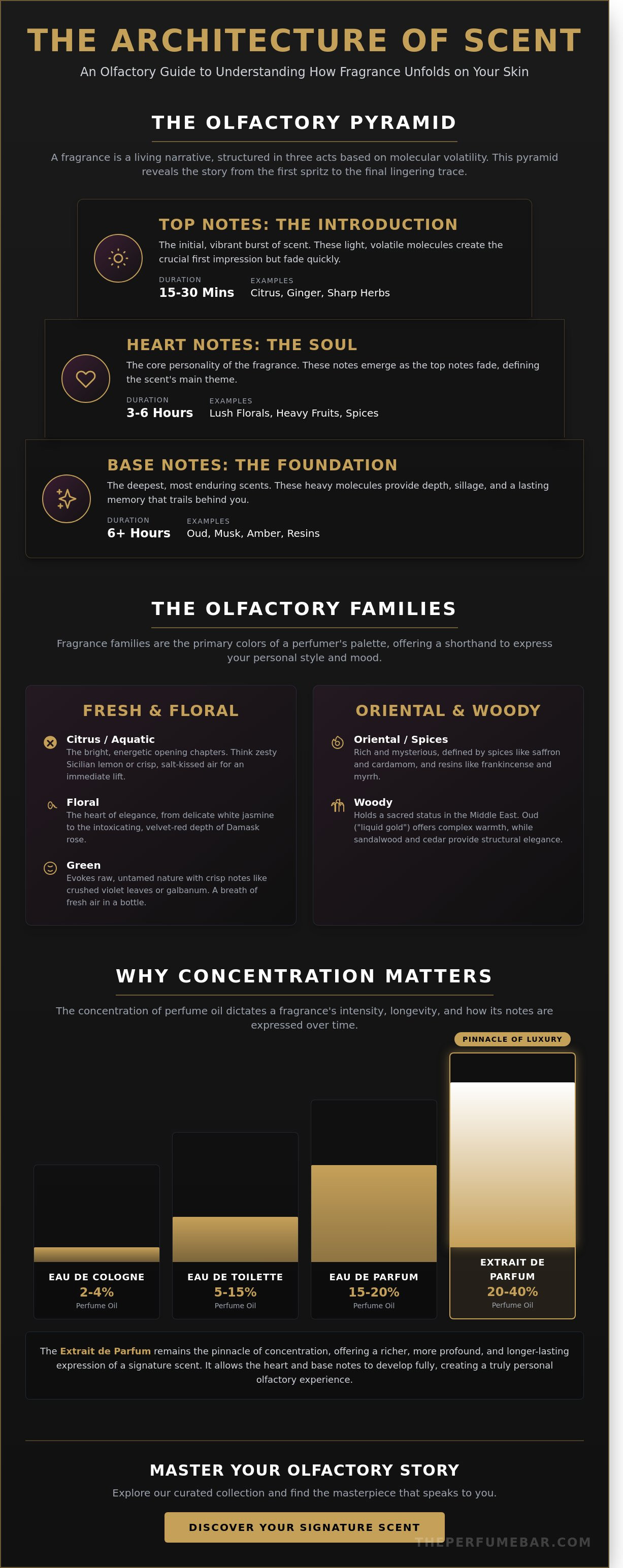
The top notes are your introduction. They're volatile and fleeting, usually lasting only 15 to 30 minutes after application. Think of bright citrus, ginger, or sharp herbs designed to make a striking first impression. The heart notes, or the "soul," emerge as the top fades. These linger for three to six hours, defining the core personality of the fragrance with lush florals, heavy fruits, or warm spices. Finally, the base notes provide the foundation. These are the deepest, most enduring scents, such as musks, amber, and resins, which provide the sillage that trails behind you throughout the evening.
Why Scent Profiles Evolve on the Skin
Your skin is the final ingredient in any bottle. Skin chemistry, particularly pH levels and body temperature, dictates how quickly different perfume notes evaporate. In the intense heat of the UAE, where temperatures frequently exceed 40°C, lighter molecules can vanish rapidly, making the structural integrity of a scent vital. High-quality natural oils interact with your unique biology in a way that synthetic molecules cannot, creating a scent that's entirely personal. The "dry down" is the final transition phase where the base notes fully settle. This is the most authentic version of the fragrance, the one that stays with you long after the initial spray has vanished.
The Olfactory Families: Categorizing the Sensory Palette
Fragrance families act as the primary colors of a perfumer's palette. They offer a sophisticated shorthand for personal style, allowing a wearer to signal their mood before a single word is spoken. In the niche world, we see a beautiful cross-pollination where a traditional floral might be grounded by a smoky, resinous base. This blending creates a complex narrative that defies simple categorization. While the family defines the scent's DNA, how body chemistry affects scent ensures that a single bottle tells a different story on every individual. In the UAE, the market for luxury fragrances reached a valuation of approximately 2.1 billion AED in 2023, driven largely by a deep-seated appreciation for these rich, multi-layered profiles.
Fresh and Floral: The Ethereal Chapters
Citrus and aquatic notes serve as the bright, energetic opening chapters of the olfactory journey. Think of the zesty spark of Sicilian lemon or the crisp, salt-kissed air of a Mediterranean morning. These perfume notes provide an immediate lift, perfect for the vibrant, sun-soaked days of Dubai. The floral family remains the heart of elegance. It spans from the delicate, whisper-soft touch of white jasmine to the intoxicating, velvet-red depth of a Damask rose. Modern perfumery has also embraced the "Green" movement. These scents use herbaceous and crisp notes like crushed violet leaves or galbanum to evoke the raw, untamed beauty of a hidden garden. It's a breath of fresh air captured in glass.
Oriental and Woody: The Intoxicating Depths
In the Middle East, the woody and oriental families hold a sacred status. Oud, often called "liquid gold," is the ultimate base note, offering a complex, animalic warmth that lingers for hours. It provides a structural elegance when paired with sandalwood or the dry, pencil-shaving crispness of Virginia cedar. Spices like saffron and cardamom, alongside rich resins like frankincense and myrrh, create a sense of mystery and cultural resonance. These ingredients aren't just scents; they're memories of ancient trade routes and evening majlis gatherings. Niche houses often experiment with these perfume notes to create bespoke experiences that feel both timeless and avant-garde. If you're ready to find your own signature narrative, you can explore our curated collections to discover a scent that speaks your language.
- Citrus: Bergamot, Grapefruit, Neroli.
- Floral: Tuberose, Peony, Iris.
- Woody: Patchouli, Vetiver, Guaiac Wood.
- Oriental: Amber, Vanilla, Tonka Bean.
The Symphony of Evaporation: Understanding Volatility and Sillage
The dance of a fragrance on your skin is governed by the laws of physics. Every bottle contains a delicate balance of molecules, each vibrating at its own frequency and escaping into the air at different speeds. This process is known as volatility. Light molecules, such as those found in citrus or herbal perfume notes, possess a low molecular weight. They leap from the skin almost instantly, offering that initial, breathtaking burst of freshness that defines a first impression. Heavier molecules, found in precious woods and ancient resins, linger much longer. They're the anchors, the soulful remnants that stay with you long after the sun sets over the Dubai skyline.
Master perfumers don't just blend scents; they manage time. By understanding how these perfume notes interact, they create a narrative that unfolds over hours. A fragrance that disappears too quickly lacks substance, while one that is too heavy can feel stagnant. The magic lies in the equilibrium. It's a calculated technical feat to ensure that the bright spark of a top note doesn't vanish into thin air before the heart has a chance to beat.
The Role of Fixatives in Fine Perfumery
In the world of high-end perfumery, fixatives act as the invisible stagehands. These substances, often derived from resins, balsams, or complex synthetic molecules, slow down the evaporation of more volatile ingredients. They're the glue that binds the composition together. Historically, natural ambergris and musk were the gold standards for this task, prized for their ability to hold a scent for days. Today, modern alternatives provide the same velvety depth while meeting the strict ethical standards of the UAE market. These fixatives ensure the transition between the fleeting top and the enduring base is seamless, creating a smooth, uninterrupted olfactory journey.
Projection vs. Longevity
It's a common misconception that a loud fragrance is a long-lasting one. Projection refers to the distance a scent travels from your body, often reaching its peak in the first thirty minutes. Longevity, however, is the endurance of the scent on the skin. You might find a bespoke oil in a local boutique that whispers softly but remains present for twenty-four hours. Conversely, an Eau de Toilette might announce your arrival from across the room but vanish by lunch. Sillage is the invisible aura of the wearer. This trail is what lingers in a hallway after you've passed, acting as a ghostly, elegant memory of your presence.
How to Read a Fragrance: Developing Your Olfactory Palate
Choosing a signature scent is an act of patience. It's a dialogue between the liquid and your skin's unique chemistry. Too often, enthusiasts make the mistake of purchasing a bottle based solely on the initial, sparkling burst of the top notes. This is the olfactory equivalent of judging a book by its cover. To truly understand perfume notes, you must embrace slow perfumery, a deliberate practice that allows a scent to unveil its narrative over several hours. In the luxury markets of the UAE, where heat and humidity influence how a fragrance radiates, this patient observation is essential.
The 24-Hour Testing Method
The first five minutes of a spray are often deceptive. These volatile molecules, usually citrus or light herbs, are designed to captivate your senses immediately. They're bright and ethereal, but they lack staying power. Don't let a fleeting burst of bergamot dictate your investment. Instead, wait for the midday check. Between two and four hours after application, the heart notes begin to bloom. This is the true character of the fragrance. In the warmth of Dubai, these floral or spicy accords often expand with a lush intensity that wasn't visible in the air-conditioned boutique.
The final test occurs the morning after. High-quality perfumes leave a lingering trail, known as sillage, that settles into the base notes. If you can still detect a whisper of creamy sandalwood, earthy oud, or rich vanilla on your skin or the cuff of your linen shirt twenty-four hours later, you've found a blend of exceptional quality. This longevity is the hallmark of a bespoke composition.
Building Your Scent Vocabulary
Developing your palate requires moving beyond simple "likes" and "dislikes." Start by identifying specific accords, which are groups of notes that create a single, distinct impression. You might encounter a "Chypre" accord, characterized by the sophisticated contrast of oakmoss and citrus, or a "Gourmand" profile that evokes edible delights like honey and toasted praline. When searching for Perfume Near Me: The Connoisseur’s Guide to Luxury Fragrances in 2026, knowing these terms helps you communicate your preferences to a specialist.
- Keep a Scent Diary: Record your emotional responses to different perfume notes. Does a particular cedarwood remind you of a desert retreat? Does jasmine spark a memory of a childhood garden?
- Distinguish the Layers: Practice smelling your wrist every hour. Notice when the sharp edges of the top notes soften into the rounded, velvet textures of the heart.
- Identify Single Notes: Try to isolate one ingredient, like patchouli or rose, within a complex blend to understand how it supports the overall structure.
A scent for the bold. A memory captured in a bottle. By taking the time to read a fragrance, you transform a simple purchase into a meaningful sensory experience. This level of discernment distinguishes the casual wearer from the true connoisseur.
Ready to discover a scent that evolves with you? Explore our curated collection of artisanal fragrances today.
The Art of the Extrait: Why Concentration Matters in Note Expression
Within the sophisticated boutiques of the United Arab Emirates, the Extrait de Parfum stands as the ultimate expression of the perfumer's craft. While an Eau de Parfum typically contains 15% to 20% oil, an Extrait elevates this concentration to a staggering 20% to 40%. This isn't merely about volume; it's about the architecture of the scent. The Perfume Bar treats these high-concentration blends as liquid poetry, where every drop carries the weight of a thousand memories. It's an intimate experience, designed for those who want their fragrance to stay close to the skin while telling a story that lasts from dawn until the desert stars emerge.
Depth and Complexity in High Concentrations
High concentrations fundamentally transform how perfume notes interact with your skin. In lighter formulations, volatile top notes like bergamot or neroli might vanish within thirty minutes. In an Extrait, the dense oil structure acts as an anchor. It allows these delicate facets to linger, weaving them into the heart rather than letting them evaporate into the heat. The dry down becomes a slow, deliberate revelation. You aren't just wearing a fragrance. You're wearing a masterpiece that evolves over twelve to twenty-four hours, revealing hidden layers of spice or resin that cheaper concentrations simply cannot sustain.
- Sustained Vibrancy: Delicate florals and citrus notes gain a new, resilient life, resisting the rapid evaporation common in humid climates.
- Rich Resonance: The base notes, such as oud, amber, or sandalwood, achieve a creamy, three-dimensional texture that feels alive.
- Sensory Value: A single 50ml bottle of Extrait often provides more depth and wear-time than multiple bottles of lighter concentrations, making it a conscious choice for the discerning collector.
Choosing Your Signature Narrative
Your fragrance is your unspoken biography. Choosing an Extrait means selecting a narrative that persists throughout the day and into the night. At The Perfume Bar, we curate these high-intensity stories for those who seek more than a fleeting impression. We understand that a signature scent should be as unique as a fingerprint. Our bespoke experiences allow you to find the perfect harmony between rare accords and personal memory. This is where the science of perfume notes meets the art of the individual, creating a sillage that is both powerful and understated.
Whether you're looking to find your own intoxicating blend or interested in bringing this world of olfactory elegance to a wider audience, the journey begins with a single scent. Explore our curated collection to discover the transformative power of high-concentration perfumery. For those with a vision for excellence, we invite you to explore our exclusive franchise opportunities within the region and join us in defining the future of luxury fragrance.
Your Future in Fragrance: Crafting a Timeless Olfactory Legacy
The journey through the intricate architecture of a scent is more than a lesson in chemistry; it's an awakening of the soul. By mastering the nuances of perfume notes, you've moved beyond the surface of retail and entered the realm of the connoisseur. You understand now how the symphony of evaporation dictates sillage. You see why the depth of an Extrait de Parfum offers a narrative that lingers long after you've left the room. It's about finding that singular accord that mirrors your own story. A scent for the bold. Since 2014, The Perfume Bar has specialized in these high-concentration experiences, curating award-winning scents and bespoke event services that define luxury across the UAE, Oman, Bahrain, and Kuwait. The right concentration ensures your presence is felt with elegance and intent. Memories captured in a bottle. Discover the Depth of our Extrait de Parfum Collection and find the story you were meant to tell. Your signature scent isn't just a choice. It's a legacy in the making.
Frequently Asked Questions
What is the difference between a perfume note and an ingredient?
A perfume note is the artistic impression of a scent, while an ingredient is the tangible raw material used to create it. Think of notes as the ethereal colors in a masterpiece and ingredients as the physical tubes of paint. A single note, like a sun-drenched rose, might require a blend of 40 different chemical components to achieve its specific, intoxicating depth.
How many notes are typically found in a single perfume?
Most modern fragrances contain between 15 and 50 distinct perfume notes to create a balanced olfactory profile. Master perfumers often layer these into a three tiered structure to ensure the scent evolves beautifully over time. In a complex niche fragrance, you might find over 100 individual components working in harmony to tell a single sensory story.
Why do some perfume notes smell different on different people?
Your unique skin chemistry, including pH levels and oil content, alters how perfume notes interact with your body. Diet and the humid climate of the UAE also play a role in how a scent projects. A woody base note might smell creamy on one person but sharp and spicy on another; it's a living collaboration between the bottle and the wearer.
Can a perfume have only one note?
Yes, a perfume can feature a single note, often referred to as a soliflore or a linear molecule scent. These fragrances offer a minimalist purity that celebrates a specific essence, such as a solitary jasmine bloom. While traditional pyramids offer a journey, single note scents provide a steady, reliable presence that doesn't change from the first spray.
What are "linear" fragrances and how do they differ from the pyramid?
Linear fragrances maintain a consistent scent from the initial spray until they fade, unlike the traditional pyramid which evolves through top, middle, and base phases. They don't have the shifting character of a tiered perfume. Many modern enthusiasts in Dubai prefer linear scents for layering, as they provide a predictable foundation that lasts for 8 to 12 hours without surprise.
How can I make the base notes of my perfume last longer?
You can extend the life of base notes by applying fragrance to well hydrated skin or using an unscented petroleum jelly on pulse points. Scent molecules cling to moisture, so a rich body cream can increase sillage by 30 percent. Applying your perfume to pulse points like the wrists and neck allows your body heat to slowly release the heavier resins and woods.
What are the most expensive perfume notes in the world?
Oud, Orris butter, and Ambergris are the world's most coveted notes, with premium Oud oil often exceeding 18,000 AED per kilogram in the local market. Orris is prized for its arduous three year aging process, making it a rare treasure for any connoisseur. These ingredients are the crown jewels of the Middle Eastern olfactory tradition, offering a timeless luxury that defines bespoke perfumery.
Are synthetic notes lower quality than natural notes?
Synthetic notes aren't lower quality; they're essential tools that allow perfumers to create scents impossible to extract from nature. While natural oils provide a raw, earthy soul, synthetics offer incredible stability and precision. Modern masterpieces often use a 50/50 balance of both to achieve an ethereal quality that's both evocative and long lasting on the skin.